Over the past six months, the Equinox Preservation Trust has discovered two forest pests on the Equinox Preserve with the potential to alter the forest for decades to come.
Emerald Ash Borer
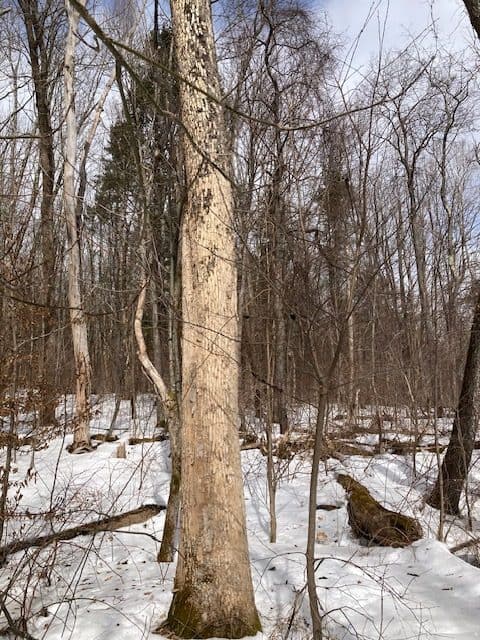
In early March, the first ash trees showing symptoms of Emerald Ash Borer (EAB) infestation were discovered by the EPT’s Forest and Trails Steward. EAB is a non-native introduced insect species. The larva of EAB live and grow in the vascular tissues underneath the bark, creating characteristic S-shaped tunnels. As an infestation spreads within an ash tree the tunneling eventually girdles the tree, choking off nutrient movement and killing the tree.
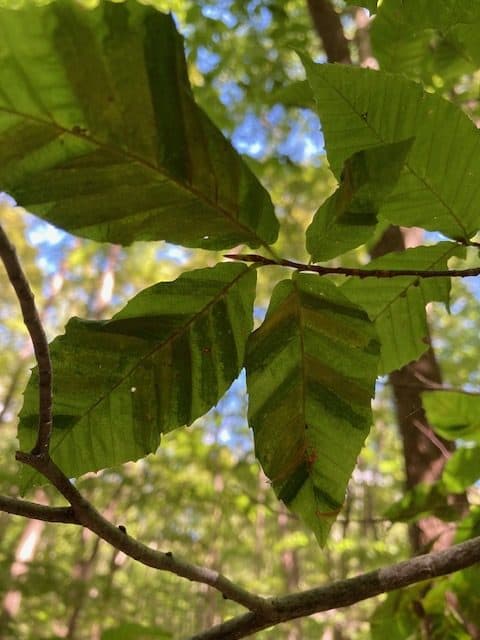
In early September, the EPT’s Steward found the first signs of Beech Leaf Disease (BLD) on several American beech saplings growing near the junction of Flatlanders and the Blue summit trails. BLD is caused by a tiny invasive nematode, originally from Japan. As populations of this nematode increase within a leaf a characteristic dark striping pattern appears between the leaf veins. The vascular function of the leaf will decrease, the leaf will become shriveled or deformed, and premature leaf loss occurs. The nematodes can also invade leaf buds, reducing leaf production for the following year. Dieback begins on the lower branches and progresses upwards towards the canopy.
In each case the EPT Steward’s first step following discovery was to conduct a widespread survey to determine the extent of the infestation and damage. With this data, EPT began to develop a strategy for managing these pests. For EAB, the easiest symptom to observe is the “blonding” or “flecking” of the bark as woodpeckers attack the tree searching for the larva. Once leaves emerged later in the spring, the EPT Steward looked for significantly reduced crown structure. Infested trees lose the ability to transport nutrients up and down the trunk, thus reducing the number of leaves in the crown. Additionally, infested trees often, but not always, produce “epicormic sprouts” which start growing from the lower trunk as an emergency way for the tree to photosynthesize.
Management Strategy
The EPT’s plan moving forward is to fell all ash trees showing EAB symptoms that are within 50 ft of a trail. Ash trees infested with EAB become quite brittle and often come apart in large pieces. Ash tree felling will begin in November 2025 and continue in future years as the infestation spreads throughout the Preserve.
While we conduct this work with the safety of trail users in mind, ultimately it is the responsibility of all trail users to be responsible for their own safety. Visitors to the Preserve should learn to identify ash trees, learn how to identify the symptoms of EAB infestation, be aware of trail conditions, and make a wise choice for their personal safety.
Beech Leaf Disease
As for BLD, there are currently many questions regarding how the nematodes spread from tree to tree and how quickly. Young trees seem to be at higher risk for mortality. Larger trees are also at-risk although the progression of symptoms and dieback appears to be slower. Because BLD moves slowly through the forest, EPT does not currently plan to fell diseased trees. Instead, we will monitor progression of the disease before determining how best to manage the beech trees on the Preserve.
Regardless, it is clear the composition of the Equinox Preserve forest will be changing significantly in the coming years as beech and ash decline and possibly disappear and other species, such as oak, take their place. For further background on EAB and BLD, please consult the VT Invasives website here: https://www.vtinvasives.org/.